
Last checked November 2, 2026.
TL;DR
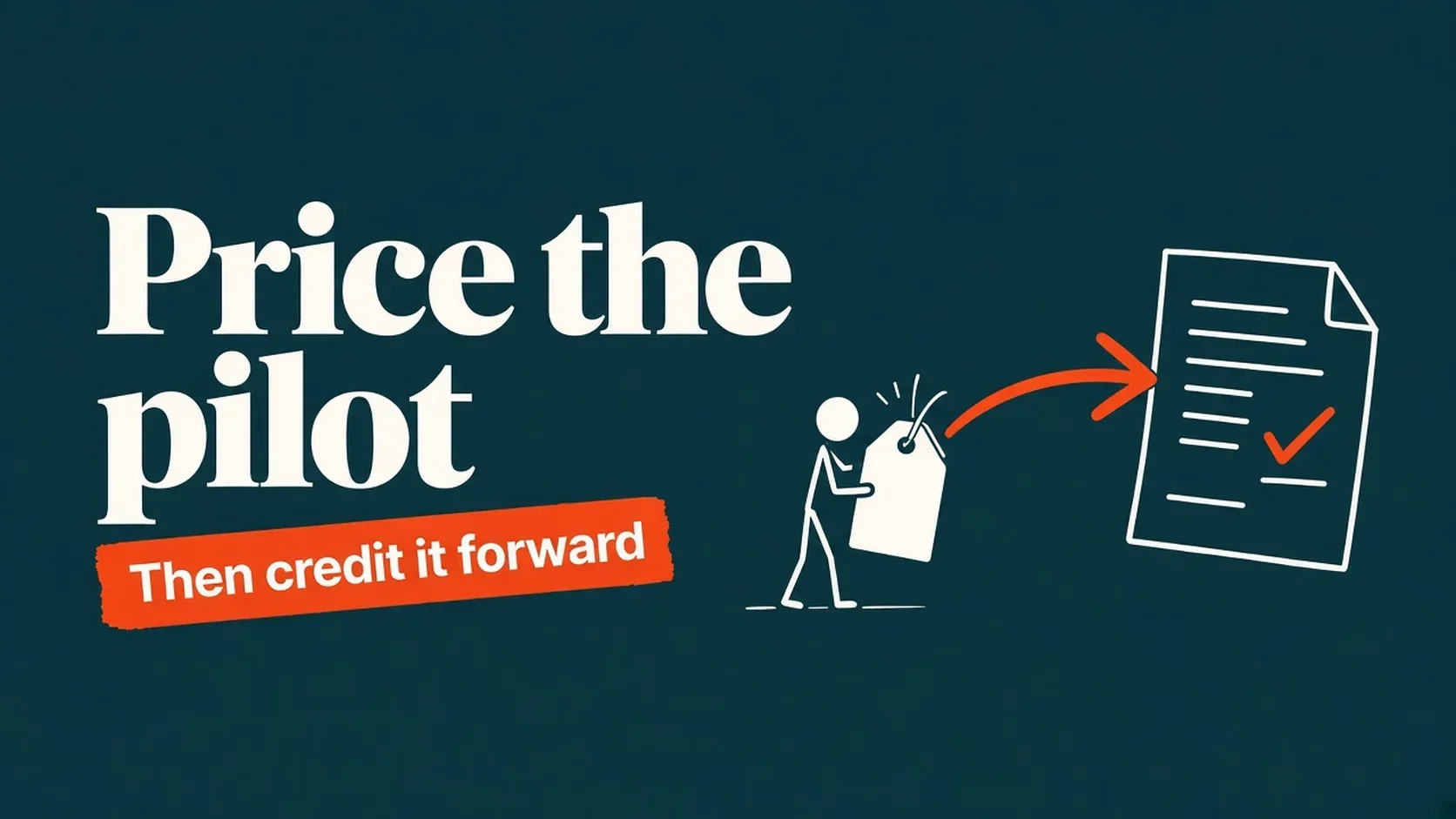
Price a paid pilot to cover delivery cost and fit the buyer’s confirmed approval limit; reduce scope if no fee can do both. As of November 2, 2026, Startup Fortune suggests 10–20% of annual contract value and Hypergility 25–40%, while RaiseMoney’s 50–100% is a credit of the pilot fee toward the contract; agree the credit, expiry and success test before work starts.
Download the pilot-fee worksheet (CSV). Inputs, a labeled fictional example, and the source links. No signup.
Should you charge for the pilot?
Charge for a pilot when you need someone at the buyer to approve spend: a fee creates a purchase, but it does not promise renewal. A free test can still make sense when you are seeking a logo and can cap the delivery hours.
- Don't expect a free test, by itself, to create a person who has practiced buying from you.
- Jason Lemkin, on SaaStr, describes paid-pilot-to-annual conversion in companies he works with as varying “fairly widely from about 60% to over 90%,” and writes that it was “well over 90% at EchoSign.” He also writes: “The more business process change involved, the lower the conversion rate likely will be.” That is his portfolio observation. The post does not publish a sample size, a time window or a definition someone else could reproduce. SaaStr, Jason Lemkin.
- Hypergility quotes Mark Preston of Hypergility: “A paid pilot at 30% of ACV outperforms a free pilot on conversion roughly 3 to 1 in our portfolio.” The page does not show how many pilots, over what period, or what “conversion” required. Use it as that firm’s reason to have the charging conversation. Do not cite it as a market conversion rate.
How much should you charge for a pilot?
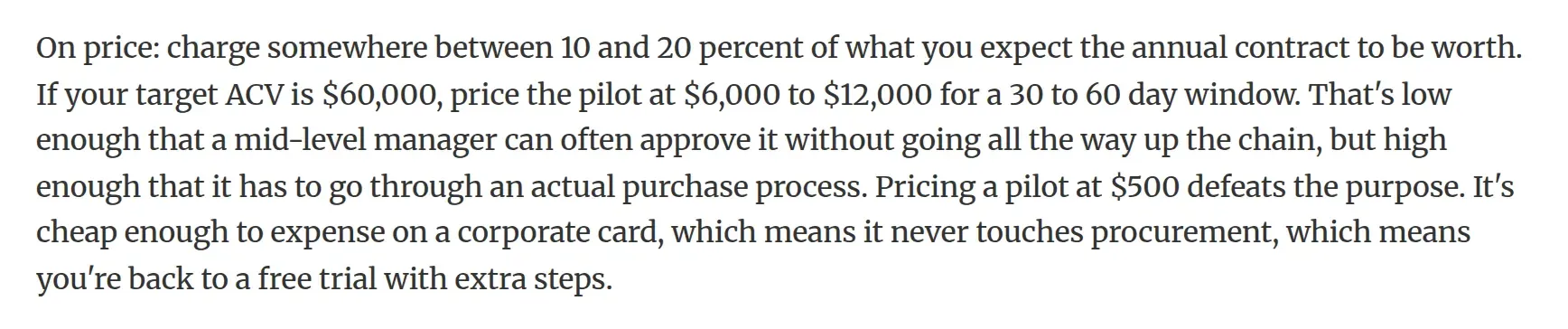
Set a paid-pilot fee by calculating delivery cost, testing an explicit fraction of expected annual contract value and checking the buyer’s approval limit. In the fictional worksheet checked November 2, 2026, 40 hours × $150 plus $400 infrastructure gives a $6,400 cost floor, and 10–20% of an $80,000 annual contract gives an $8,000–$16,000 fee band before any approval limit.
Replace every input below with your own estimate; the example is not a rate card.
Length is blank, so it is not part of this example. Startup Fortune’s example is 30–60 days. RaiseMoney’s scope table says 30–60 calendar days and calls an open-ended trial past 90 days a high-risk pattern. Hypergility says 6–10 weeks. Length does not change the fee.
Illustrative until you replace the inputs. Delivery cost is $6,400. The suggested fee is the higher of that cost and the band you are testing. Startup Fortune’s 10–20% (October 4, 2026) is $8,000–$16,000. Hypergility’s 25–40% (May 21, 2026) is $20,000–$32,000. No approval limit is entered, so nothing here is capped by one. RaiseMoney (September 22, 2026) credits 50–100% of a fee you already set. On the worksheet rule, the greater of the cost floor and 10% of the contract, that fee is $8,000 and the credit is $4,000–$8,000.
| Source | What it tells you | Fee to test | Credited if they convert | Year-one cash if they convert | Within their limit |
|---|---|---|---|---|---|
| Startup Fortune | 10–20% of the annual contract, then credit that fee against year one. The credit expires. | $8,000–$16,000 | $8,000–$16,000 | $80,000 | ! Ask |
| Hypergility | 25–40% of the annual contract, credited against year one if they sign. | $20,000–$32,000 | $20,000–$32,000 if they sign | $80,000 | ! Ask |
| RaiseMoney | Not a percent of the contract. Credit 50–100% of the fee if they convert within 30 days. | Sample fee $8,000 | $4,000–$8,000 | $84,000 at 50%. $80,000 at 100%. | ! Ask |
Dates on the pages: Startup Fortune, October 4, 2026. Hypergility, May 21, 2026. RaiseMoney, September 22, 2026.
✓ Fits. ✕ Over the limit. ! means ask the champion, cap the top of the band, or start from the cost floor because the percent landed under it. Year-one cash uses annual contract + fee − credited amount. When the whole fee is credited, that is the annual contract. Fractions checked November 2, 2026.
Startup Fortune’s own illustration is a $60,000 contract priced at $6,000–$12,000 over 30–60 days. The worksheet’s $80,000 is a separate, fictional contract, so you can see the same 10–20% on a different number.


Then ask what the problem already costs the buyer. Hours saved, an outage avoided, or a fine they already model. Write their number down. The question to ask: what does this cost per month, and what fraction of one month will you pay to test a fix?
How to credit the pilot toward the annual contract
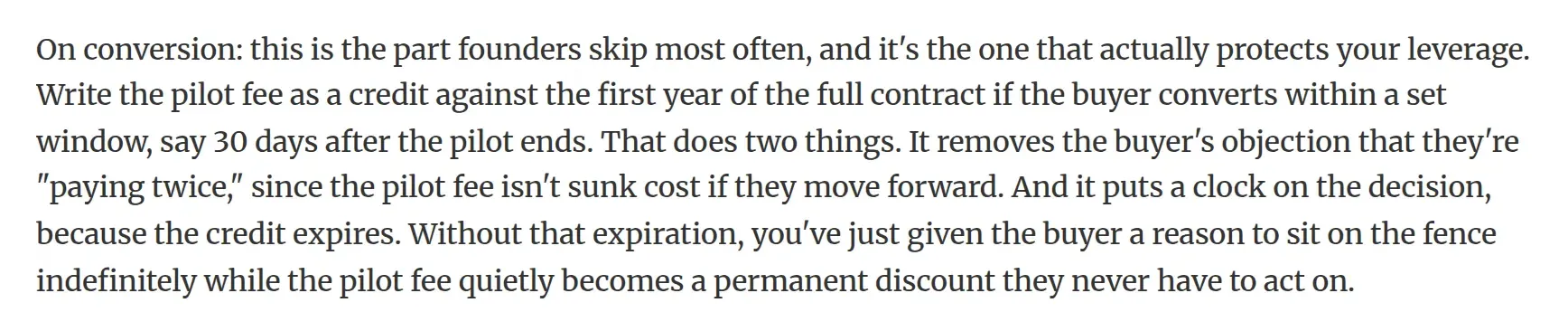
Write the pilot credit as a fraction of the fee, an expiry date and the amount still owed on conversion: year-one cash = annual contract + pilot fee − credited amount. In the fictional worksheet checked November 2, 2026, an $8,000 fee fully credited toward an $80,000 annual contract leaves total year-one cash at $80,000; a 50% credit makes it $84,000.
- RaiseMoney credits 50% to 100% of the pilot cost against first-year ARR or ACV when the buyer converts within 30 days.
- Startup Fortune credits the pilot fee against the first year, and the credit expires. Their example window is 30 days after the pilot ends.
- Hypergility credits the fee against the year-one contract if they sign. Copy the structure you mean into the agreement.
- Fictional example. Fee $8,000, credit 100%, annual contract $80,000. Year-one cash is $80,000. The fee was prepaid contract value, not extra revenue. Formula: annual contract + fee − credited amount.
- If they never convert, year-one cash is the $8,000 fee. Delivery cost in the example is $6,400.
- If you credit only half, the credited amount is $4,000 and year-one cash on conversion is $84,000. Change the inputs. Do not memorize the example.
- A success-based structure, where part of the fee is due only if the written test is met, is a different deal. None of the three posts publishes how often that second invoice is paid. If you use it, the success test has to be the same sentence in the statement of work and on the invoice.
What can the buyer approve without a new budget?
Only the buyer can confirm what they can approve without a new budget; ask the champion what they can sign this quarter and leave the worksheet’s limit blank until they answer. Public procurement thresholds and program award ceilings do not establish a private company’s approval limit.
| Anchor | Use it as their limit? |
|---|---|
| The champion’s own number | ✓ Yes Leave it blank until they answer. |
| FAR micro-purchase threshold, $15,000 | ✕ No A US federal definition, with exceptions. Not a corporate card limit. |
| SBIR Phase I $335,937 and Phase II $2,239,578 | ✕ No Award ceilings as of October 16, 2026. Not a pilot price. |
| 100+ Accelerator, maximum pilot budget $100,000 | ! Check That program’s ceiling. Applications are closed. Not your statement of work. |
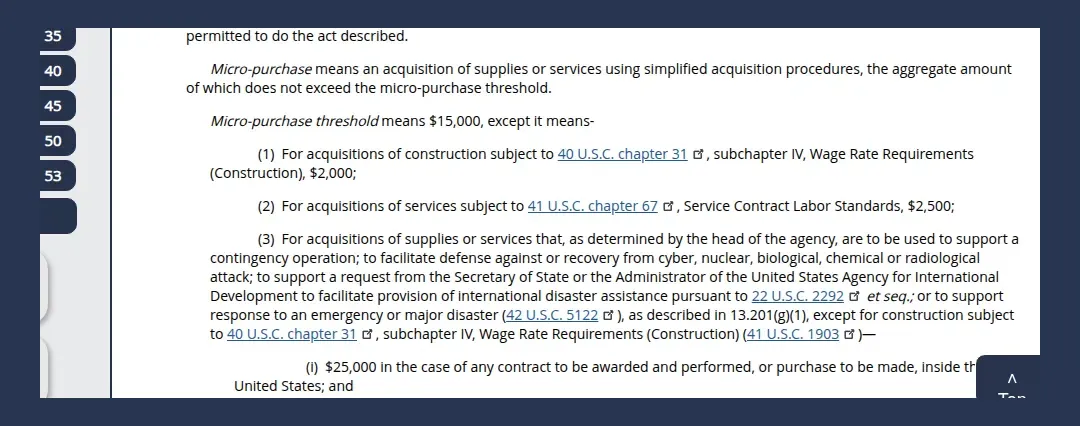
The federal micro-purchase threshold is $15,000. FAR 2.101 says: “Micro-purchase threshold means $15,000,” with exceptions. Those exceptions include $2,000 for construction subject to the Wage Rate Requirements, and $2,500 for services subject to the Service Contract Labor Standards, plus higher thresholds for defined contingency and disaster support. FAR 2.101. That clause is US federal simplified acquisition. It is not a corporate card limit, and it is not a state or local rule.
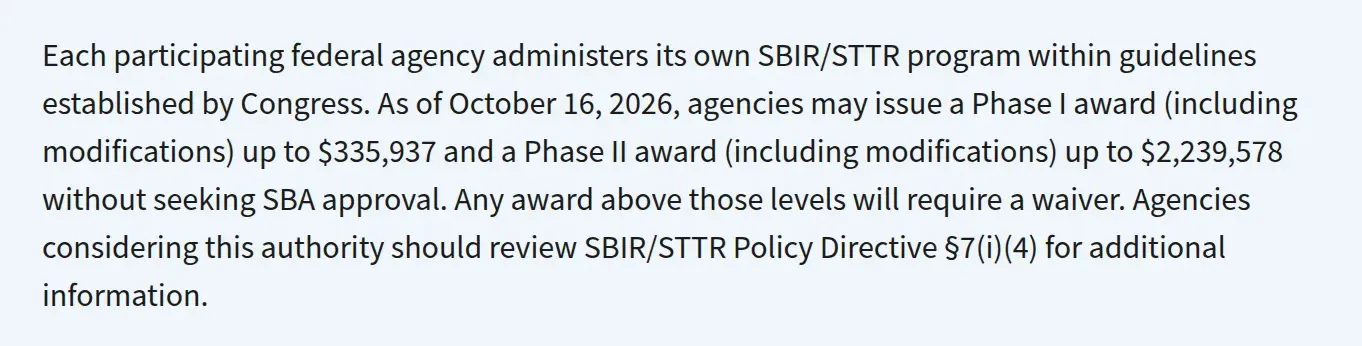
SBIR and STTR award caps are not pilot prices. “As of October 16, 2026, agencies may issue a Phase I award (including modifications) up to $335,937 and a Phase II award (including modifications) up to $2,239,578 without seeking SBA approval.” SBIR.gov. A Phase I award and a paid pilot with a program office are different vehicles. The cap is the approval line for those awards. It is not what to charge a corporate innovation team.
One corporate program publishes a pilot budget ceiling. The 100+ Accelerator FAQ says the maximum budget is $100K, and that startups are encouraged to propose less, for example $50K. The homepage says applications are now closed. Our paid pilot directory records that route as closed. The $100,000 figure is that program’s ceiling, not the price of your statement of work.
Rules and program pages checked November 2, 2026.
What belongs in the agreement?
The pilot agreement should name the fee, credit fraction, credit expiry, success test and person who can approve the annual contract. Settle data access, security review, IP, reference rights, exclusivity and termination in the agreement before work begins.
- Do name the success test, in the same sentence on the statement of work and on the invoice.
- Don't treat the worksheet as contractual terms. It does not supply them.
- Don't give perpetual IP, exclusivity in the buyer’s sector, roadmap control or unlimited support hours. That list is Hypergility’s commercial advice, not a statute. Have counsel read the grant if it is broad.

The directory of corporate and public programs already lists what to settle before you commit people: who owns the pain, who can buy, what you are delivering, what counts as success, and what happens afterward. Use that section of the paid pilot directory rather than a second checklist.
Quick answers
Give a paid pilot a fixed end date, a scoped deliverable and an explicit conversion decision. A fee establishes a purchase, but neither payment nor a successful technical test guarantees an annual contract.
How long should a paid pilot run?
- The three pages do not share one length.
- Startup Fortune’s example is 30–60 days.
- RaiseMoney’s scope table says 30–60 calendar days and calls an open-ended trial past 90 days a high-risk pattern.
- Hypergility says 6–10 weeks.
- Pick a length that matches the test you can finish, and write the end date. Length does not change the fee math above.
Is a free pilot a mistake?
- Not always.
- It is a mistake when you needed a purchase and you gave away a project instead.
- Lemkin’s range is about paid pilots in companies he works with, and he says more business-process change lines up with lower conversion.
- A fee gives the buyer something to approve. It does not guarantee they convert.
What if they want exclusivity or the IP?
- Hypergility says a pilot should not include perpetual IP, exclusivity in the buyer’s sector, roadmap control or unlimited support hours.
- That is one firm’s commercial advice, not a statute.
- Get the term in the agreement.
- Have counsel read it if the grant is broad.
How do you price a government pilot?
- For a US federal buy under simplified procedures, read FAR 2.101 rather than a blog range.
- The micro-purchase threshold is $15,000, with the exceptions above.
- SBIR Phase I and Phase II caps, $335,937 and $2,239,578 as of October 16, 2026, are award ceilings for those programs.
- Ask the agency which vehicle they are using before you treat either number as your price.
Key takeaways
Start a paid-pilot quote with delivery cost and the buyer’s approval limit, then state how much of the fee will be credited toward an annual contract. A percentage suggestion is a model to test against that scope, not a measured market price.
- Set a cost floor from hours and infrastructure before you apply any percent. In the worksheet, 10% of a fictional $80,000 contract clears a fictional $6,400 floor. Your contract might not.
- The published suggestions are Startup Fortune’s 10–20% of annual contract value, Hypergility’s 25–40%, and RaiseMoney’s 50–100% credit of the fee. They measure different things.
- Ask the champion for their approval limit. The federal micro-purchase threshold of $15,000 is a FAR definition, not their card limit.
- Write the credit, its expiry and the success test into the pilot agreement. The paid pilot directory is the list of what else to settle before you commit people.
- Hypergility names a £6,800 median and an OpenView benchmark, without a link. That is not a price to use.
Related: Paid pilot programs for routes a company will pay to test, founder cold-email examples for the note that asks for the conversation, and Attio vs folk if the account you are piloting needs a CRM record.
Sources
Pages used for the fee, credit and threshold figures above, checked November 2, 2026:
- Startup Fortune: how to price an enterprise pilot
- Hypergility: price your first paid pilot
- RaiseMoney: paid pilot for startups
- SaaStr: paid-pilot-to-annual conversion
- FAR 2.101: definitions and micro-purchase threshold
- SBIR: program overview and award caps
- 100+ Accelerator FAQ: pilot budget
- 100+ Accelerator: application status