










The meeting you want ends with a buying decision
Imagine two invitations from the same large company.
One offers workshops, introductions and the possibility of a pilot. The other has a business-unit problem, a purchasing process and money for testing your product.
Both might arrive under a “startup innovation” banner. Only the second has described a buyer.
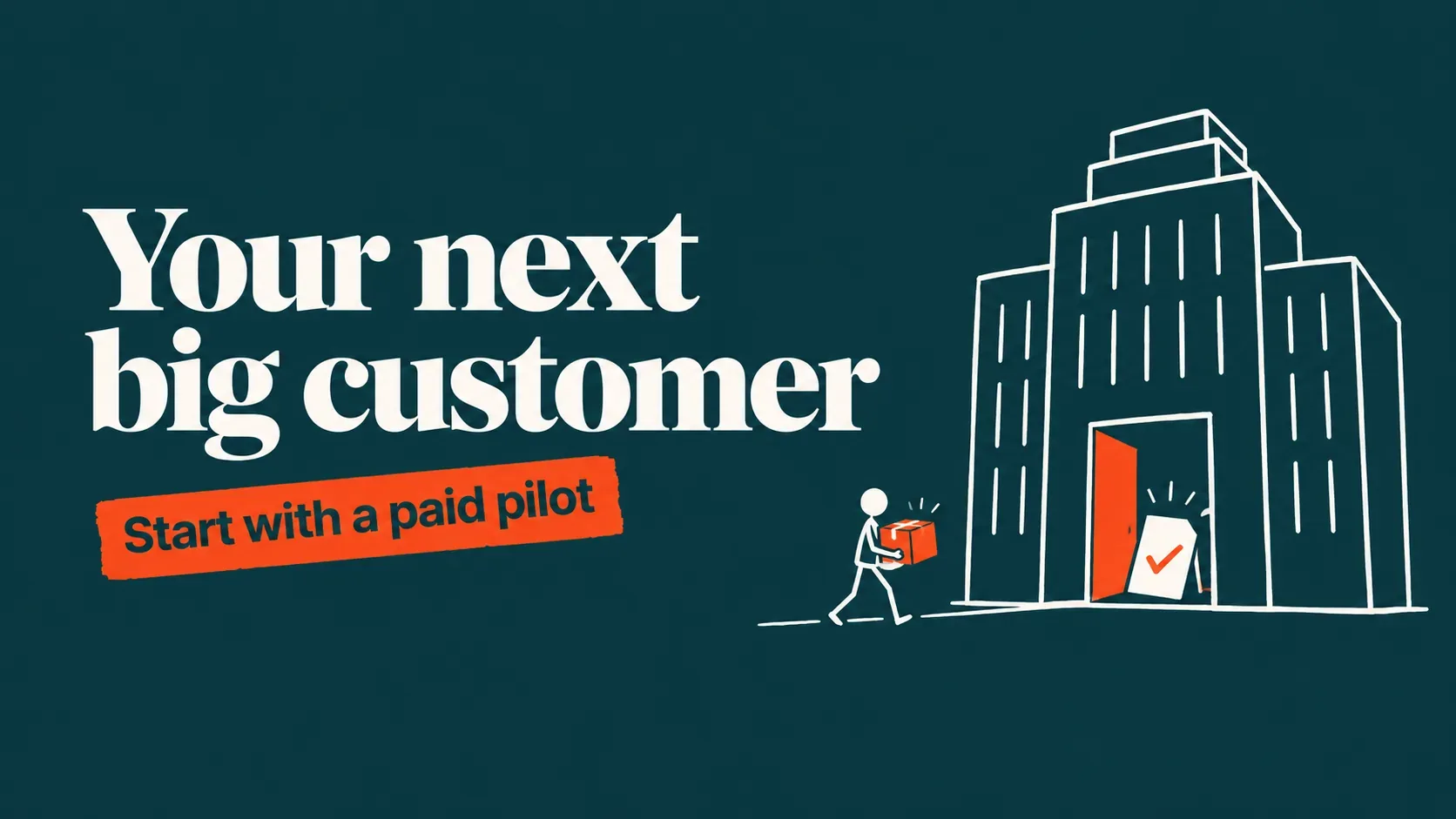
Venture clienting is a route for a company to become an early customer of a startup. The useful question is not whether it has an innovation team. It is whether that team can help someone buy what you sell.
That distinction matters especially for a small B2B team. A prestigious unpaid experiment can consume the engineers you need for paying customers. A tightly scoped paid test can produce revenue, product feedback and a reference, provided the contract actually permits one.
Use the directory above to find a relevant route. Use the working brief to establish what must be true before you commit people to it.
Which programs explicitly describe paid pilots?
In this selected directory, BMW Startup Garage, Open Bosch, BSH Startup Kitchen, Holcim MAQER’s venture-client route, BIND Open Innovation and BIND GovTech explicitly describe purchases or paid projects. The two BIND routes are waiting for their next calls in the October 12 snapshot. This is six routes, not six open corporate applications.
Siemens Collaborate separately says it covers PoC development costs. We label that cost support, because a covered project budget and unrestricted cash are different offers. Siemens’ current program and FAQ explain the scope.
| What is actually offered? | Evidence to look for | What you still need |
|---|---|---|
| Paid purchase or pilot | Purchase order, paid-project or compensation language | Price, scope, invoice and payment dates |
| PoC cost support | Named development costs covered | Covered costs, recipient and payment mechanism |
| Pilot funding | An implementation budget | Eligible expenses, milestones and timing |
| Customer / partnership access | Evaluation, introductions or testing | A buyer and an agreed commercial contract |
The labels describe the published model, not money committed to your startup. Every selected project still needs agreement on terms.
You do not have to sell car parts to sell to a car company
An enterprise buys software for operations, data, support and security as well as its end product. That opens a more interesting question for a technical founder: which internal team has the problem your product already solves?
Three published examples make the opportunity concrete:
- Data infrastructure: BMW’s program page includes a Vendia account of working with teams on real-time data applications. The relevance is an internal data problem, not a startup building a vehicle. BMW program examples.
- AI for industrial operations: Bosch describes SPARETECH’s spare-parts platform deployed at more than 22 Bosch Mobility plants after a multi-year relationship. That is evidence of adoption beyond an initial test, not a general pilot conversion rate. Open Bosch case studies.
- A specific regulatory customer need: Volvo describes working with AiDEN to bring a digital compliance service into Volvo Connect and the truck interface, with pilot commercialization within a year. The starting point was a defined customer problem. Volvo’s February 2026 account.
These are company-reported cases. They establish that a route has produced real collaboration; they do not disclose startup profit, contract value or your likelihood of winning.
The disqualifier belongs before the application
A founder with a working prototype can still be too early for a particular route.
BMW and BSH publish funding or accelerator prerequisites alongside product and team requirements. BIND requires a registered company, an MVP and a company age of no more than eight years. Its worldwide eligibility also comes with required in-person participation in Spain. See the linked evidence in each directory entry.
For a US team, “international program” is not enough. Confirm which legal entity would buy from you, whether your location is accepted, where work must happen and who funds travel. We leave these unknown when the reviewed source does not settle them.
A sensible first pass is three to five programs with a close use-case fit. Put the rest aside. A small list with a real buyer hypothesis is more useful than an application queue with twenty famous logos.
What should you send a corporate pilot team?
Send a buying hypothesis, not your full fundraising story. Here is an illustrative example, not an actual company’s proposal:
Your supplier-operations team manually resolves duplicate records. We propose testing our matching software on an agreed, access-controlled sample for six weeks. We will measure precision, review time and exception handling against your current process. Before work begins, we would agree the pilot price, acceptance owner and decision date for a wider deployment.
It contains a customer problem, a limited scope, measurable proof and a commercial next step. It leaves room for the buyer to correct your assumptions.
Before you name a fee, use the paid-pilot pricing worksheet to check delivery cost, the buyer’s approval limit and the credit toward an annual contract.
The downloadable brief adds the questions a polished pitch can hide:
- Who owns the pain? Name a business-unit sponsor who needs the result.
- Who can buy? Identify the budget owner and the legal purchasing entity.
- What are you delivering? Bound integration, support, travel and custom development.
- What counts as success? Agree a baseline, target and acceptance decision.
- What happens afterward? Name the rollout decision, owner and budget process.
Also settle data access, security review, IP, reference rights, exclusivity and termination in the actual agreement. This worksheet is a preparation aid; it does not supply contractual terms.
Watch the gap between “pilot” and “customer”
Comcast LIFT Labs makes the distinction explicit: its current FAQ says a pilot, PoC or follow-on engagement is not guaranteed. That does not make the program worthless. It means you should evaluate access as access until there is a commercial commitment. LIFT Labs program FAQ.
A different trap is treating a closed call as available pipeline. The 100+ Accelerator advertises up to $100K for pilot implementation, but applications are closed in this snapshot. Bookmarking that route is reasonable; counting it in this quarter’s revenue forecast is not. 100+ Accelerator.
Verdict
For a startup with a test-ready product, corporate pilot programs deserve a place beside ordinary enterprise prospecting. Start with a documented purchase model and a matching business problem.
| Your situation | Best next move |
|---|---|
| Working product; strong buyer fit | Qualify a paid-pilot route and scope the test |
| Useful technology; payment unclear | Ask about budget and buying process before custom work |
| Idea only | Build and validate further; most routes here need something testable |
| Suitable route, closed call | Track reopening; keep selling elsewhere |
| Pilot succeeded, no rollout owner | Resolve the next buying decision before extending the experiment |
The win is a customer relationship you can serve economically. A program badge, demo day or successful technical test does not establish that on its own.
How this directory is maintained
This is a selected comparison of 13 routes across 12 organizations/platforms, including two BIND programs. It is not a census or a ranking. We reviewed official program pages and FAQs on October 12, 2026; sources sit beside every entry. We did not apply, obtain private contracts or independently audit the case studies.
Payment descriptions, availability and prerequisites are separate fields. “Contact route” means the page offers a way to start a conversation, not that a funded intake is open. Unknown terms are shown rather than filled from old cohorts. Recheck featured application windows weekly and all terms before applying; the displayed date changes only after a source review.
For other ways to reduce the cost of building, compare startup perks and credits. If you need structured company-building support before a buyer can test your product, use the accelerator directory. When a pilot is worth reporting, the investor-update template is where started, completed, and blocked stay distinct. When that pilot becomes an account you have to track, Attio vs. folk compares two CRMs by fit before price.